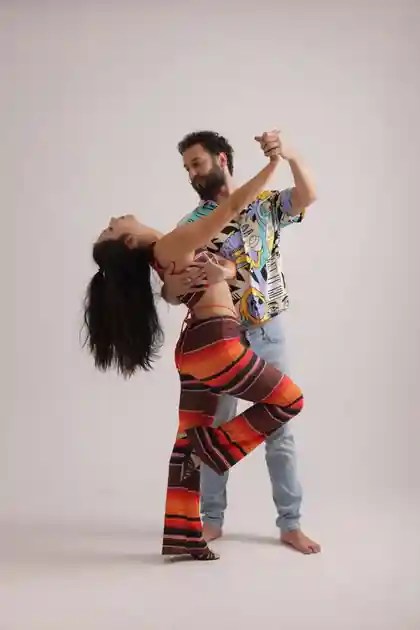
Independent Dance Coaching
Developing a learner-focused approach to private dance coaching.
I kept the strong technical foundation I learned at JDance, then shifted private teaching toward the needs of the learner in front of me rather than simply following my planned agenda.
The problem
Some learners needed more than additional moves or corrections. Progress could be blocked by tension, timing, comfort, coordination or the way the lesson itself was structured.
What I did
I observed where each learner struggled, isolated the underlying friction, changed the exercise and retested it, adapting drills and feedback to the person in front of me.
Where it ended
The work produced repeat paid lessons, referrals and learner-reported progress. The deeper version of the service developed faster than its positioning, and I did not pursue it long enough to establish it as a standalone offer.
Starting point
JDance apprenticeship + about one year as an instructor
Independent practice
Paid 1:1 + online coaching · repeat learners · packages · referrals
Project material
Signed qualification + 13 archived student message histories
What changed
Technique coaching expanded into deeper observation and individualized intervention
01 · JDance foundation and later private practice
Starting with a strong technical teaching foundation.
At JDance, I moved from informally helping other dancers into an apprenticeship of roughly three months, then worked as a JDance instructor for about a year. I taught the school’s existing eight-class cycle rather than starting my own business or designing the program from scratch.
Teaching path
Dance experience
Years of technical practice and partner work.
JDance apprenticeship
Learn demonstration, explanation and correction.
Group instruction
Teach an established eight-class cycle.
Private coaching
Adapt the method around one learner at a time.
JDance gave me a strong base in technique, fundamentals, demonstration, explanation and correction. Years later, when I returned to paid private teaching in Da Nang and online, I kept those foundations and began adding a more individualized way of diagnosing where a learner was getting stuck.
Teaching foundation · original artifact

02 · Letting the learner’s needs shape the lesson
Moving away from teaching to my own agenda.
Private lessons gave me room to stop treating the material I had planned as the main measure of a good lesson. If a learner was stuck on something more basic, or responded in a way I had not expected, I could stay with that problem and change the lesson around what they actually needed.
Learner-focused loop
Observe
Notice timing, tension, hesitation and coordination.
Find the friction
Identify the smaller problem beneath the visible mistake.
Change the exercise
Slow, isolate, exaggerate or change the conditions.
Retest
See what changed and adapt again.
I watched what changed when someone slowed down, became uncertain, led another person, repeated the same movement, or reached the part they usually avoided. Technique still mattered, but so did posture, breathing, muscular tension, body language, hesitation and where the learner seemed to lose confidence or control.
03 · Cross-domain transfer
Adapting behaviour-learning ideas into movement practice.
Force-free dog training had given me a practical language for observation, reinforcement, breaking problems into smaller parts and changing the conditions around a learner. I adapted that logic to human movement.
The exercises became experiments: exaggerate the range, slow the movement down, isolate one instrument, narrow the body part being used, track breath and tension, remove visual information, or interrupt the learner’s default pattern and see what changed.
“Super happy about the progress.”
Anika
“Transformative for my dancing.”
Beha
04 · Deeper method
When the teaching method moved beyond the original service.
Sometimes movement exposed tension, avoidance, self-consciousness, control or discomfort that a learner connected to something outside the dance itself. I became interested in working with those patterns through movement and reflection, and a small number of learners wanted to explore that with me.
Most people were still booking private bachata lessons. I had not repositioned the service around the deeper method, and some clients did not want that kind of work. I tested the idea with a few learners, but stopped before finding out whether it could become a viable standalone offer.

